
A practical guide for Kenyan leaders and HR teams, with a free template
Walk through almost any office in Nairobi today and you’ll find someone drafting an email, summarising a report or polishing a proposal with ChatGPT, Copilot or Gemini. Often on a personal account. Often on their phone. Usually without anyone in leadership knowing.
That isn’t a crisis. It’s a sign your people want to work faster and better. But without a few clear rules, the same habit that saves an hour can leak a client’s details, put a wrong figure in front of a board, or land your organisation on the wrong side of the Data Protection Act.
The answer isn’t to ban AI. Bans rarely work: people simply use it quietly. The answer is a short, clear AI-use policy that tells staff what’s encouraged, what needs care, and what is never allowed.
This guide explains what that policy should cover, how to roll it out in 30 days, and where Kenyan law comes in. At the end you can download a free template to adapt for your organisation.
Why “we’ll deal with it later” is a risk
Most of the risk sits in five places.
1. Client and staff data. When someone pastes a customer list, a payslip or a patient note into a public AI tool, that personal data leaves your control and, in most cases, leaves Kenya. Under the Data Protection Act, 2019, your organisation remains responsible for it. Section 25 requires personal data to be processed lawfully, kept to what is necessary, and not transferred outside Kenya without proof of adequate safeguards or the person’s consent. Some information is treated as sensitive personal data, including health status, ethnic origin, biometric data, property details, marital status and family details, and needs even more care.
2. Confidential business information. Board papers, tender documents, pricing, legal advice and unreleased results don’t belong in a public tool, whatever its settings say.
3. Wrong answers with your name on them. AI tools write confidently, even when they’re wrong. A made-up statistic or a misquoted regulation in a client report damages trust quickly, and “the AI wrote it” is not a defence.
4. Decisions about people. Section 35 of the Act gives people the right not to be subject to a decision based solely on automated processing where it significantly affects them. Screening CVs, scoring staff or deciding on a customer’s application with AI, and no meaningful human review, is a risk.
5. Ownership and copyright. Who owns a report, a logo or a training video produced with AI? Your policy should say so, and staff should know not to feed other people’s copyrighted material into tools carelessly.
The penalties are real. The Data Commissioner can issue fines of up to KSh 5 million, or 1% of annual turnover for an undertaking, whichever is lower (section 63). The bigger cost is usually reputational.
What the regulator is signalling
Kenya doesn’t yet have a dedicated AI law. The Kenya Artificial Intelligence Strategy 2025–2030, launched in March 2025, notes that gap and sets out work towards a regulatory framework.
In the meantime, the Office of the Data Protection Commissioner (ODPC) has been working on guidance. A draft guidance note on artificial intelligence, reported in August 2026, makes a clear point: organisations that use AI systems remain accountable for personal data, even when the processing is done by an overseas vendor. Press coverage of the draft also says it expects a written data processing agreement with AI vendors that handle personal data. It’s still a draft, so watch for the final version. The direction of travel is obvious: “we didn’t know staff were using it” will not be a good answer.
A simple internal policy is the cheapest way to show you’ve taken reasonable steps.
What a good AI-use policy covers: 8 sections
Keep it to two pages. If staff can’t read it in five minutes, they won’t.
1. Purpose and scope. One paragraph: we encourage the responsible use of AI to improve our work, and this policy applies to all staff, contractors and interns, on work and personal devices, whenever the work is ours.
2. Approved tools. List the tools staff may use for work, for example your organisation’s Microsoft 365 Copilot or a business ChatGPT account, and say how to request a new one. Business versions usually offer stronger data controls than free personal accounts. Check each vendor’s terms.
3. What must never be entered. This is the heart of the policy. Be specific: client names with their details, ID and KRA PIN numbers, M-Pesa or bank details, payslips, medical information, passwords, board papers, legal advice, tender documents and unreleased financial results.
4. Checking AI output. Whoever uses AI owns the result. Facts, figures, names, dates, legal and regulatory references must be checked against a reliable source before anything leaves the building.
5. Being open about AI use. Decide when to tell clients or colleagues that AI helped, for example in research summaries, translated documents or images. Never present AI-generated work as independent professional advice without review.
6. Decisions about people. AI may help organise information, but a person makes and owns any decision about hiring, discipline, performance, credit or services, and can explain it.
7. Training and support. Everyone gets a short induction on the policy and on using approved tools well. Name a person staff can ask.
8. Mistakes, reporting and review. If confidential or personal data is entered by mistake, report it immediately. Your data-breach process applies; under section 43, a qualifying breach must be reported to the Data Commissioner within 72 hours. Review the policy every six months, because the tools change fast.
The traffic-light list: the page staff will actually use
Most people won’t memorise a policy. They will remember a simple list. Put this on one page and pin it in every team channel.
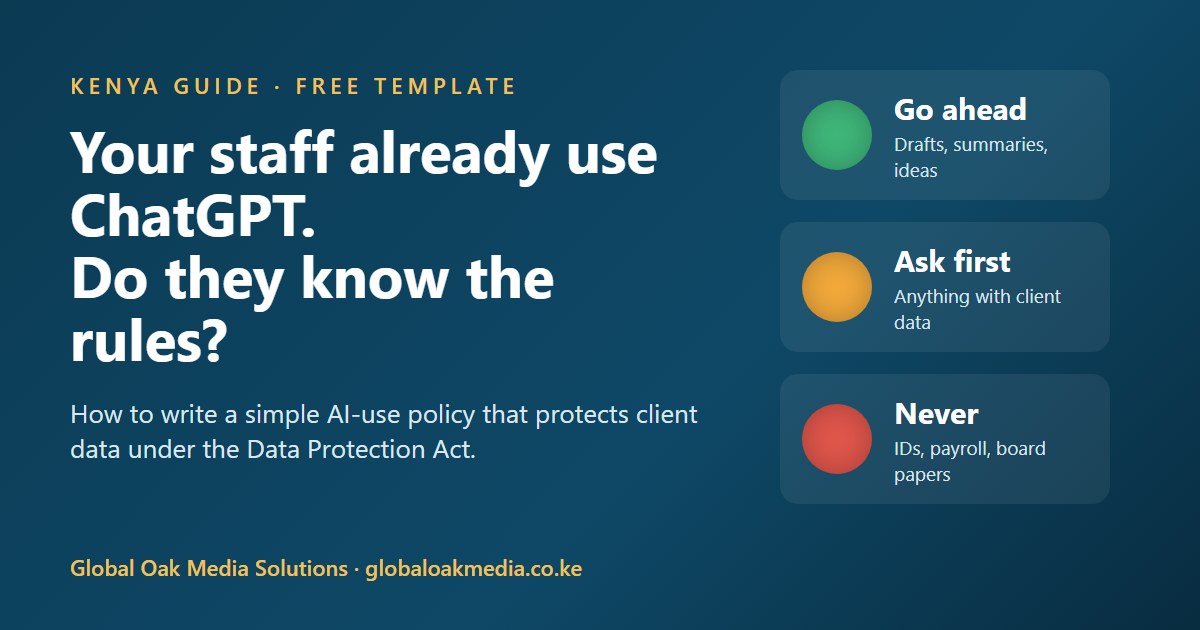
🟢 Green: go ahead (approved tools)
- Drafting emails, letters and social posts from your own notes
- Summarising public reports, articles and your own non-confidential documents
- Brainstorming ideas, headlines, agendas and training activities
- Improving the grammar and tone of your own writing
- Explaining a formula, a concept or a piece of software
🟠 Amber: ask first or anonymise
- Anything involving client or staff information: remove names and identifying details first
- Internal reports, minutes or financial data that aren’t public
- Content that will be published under the organisation’s name
- Using a new AI tool or app that isn’t on the approved list
🔴 Red: never
- ID numbers, KRA PINs, bank or M-Pesa details, passwords
- Health, HR disciplinary or payroll records
- Board papers, legal advice, tenders or unreleased results
- Making a final decision about a person based only on AI output
- Copying AI output into client work without checking it
Rolling it out in 30 days
Week 1: find out what’s happening. Ask staff, without blame, which tools they use and for what. You’ll learn a lot, including which uses are genuinely saving time.
Week 2: draft and agree. Adapt the template, agree the approved tools, and have management sign it off. Involve HR and whoever handles data protection.
Week 3: train, don’t just circulate. A policy emailed as a PDF changes nothing. A short, practical session where staff use AI on their own tasks, with the traffic-light rules built in, changes habits. People leave knowing what good looks like, not just what’s forbidden.
Week 4: support and adjust. Set up a channel for questions and good examples. Collect what’s working and update the policy at the six-month review.
A policy should make people braver, not more afraid
The organisations getting real value from AI in Kenya aren’t the ones with the strictest rules. They’re the ones where staff know exactly where the lines are, so they use the tools confidently inside them. A good policy gives permission as much as it sets limits.
Download the free template
Our AI-Use Policy Template is a short Word document you can adapt in an afternoon. It has the eight sections above, plus a one-page traffic-light list to pin up and a staff sign-off.
Get the AI-Use Policy Template (Word, free)
Enter your details and we’ll show the download link straight away and email you a copy.
The template is general guidance, not legal advice. Have it reviewed against your organisation’s own obligations.
Want help putting it in place?
We run AI at Work sessions for Kenyan organisations:
- a 90-minute Leadership AI Briefing for boards and senior teams
- a hands-on Staff Workshop, where your people learn to use AI on their real work within clear rules
- the AI Kick-off, which combines both with a draft AI-use policy tailored to your organisation
See the AI at Work programmes · WhatsApp us
Related reading: Why most AI initiatives fail at the executive level
Nelson Karanja, MBA, is Founder and Director of Global Oak Media Solutions in Nairobi. He has 30 years’ experience in finance, learning and leadership development in Kenya and the UK.